Saturday, 21 September 2013

One good Tern...

Well it's been a while but as the summer months have mainly been about lepidoptera and trying to the get the garden in order I've not really been that inclined to post much.

Now that Autumn is upon us and there are some birds about perhaps it's time I started this blogging malarkey again. I was asked to cover a couple of sectors for the Poole Harbour WeBS count last Sunday afternoon and being an amiable sort of chap I acquiesced (one good turn...). The weather forecast was proper hardcore with force lots of wind and lashings of rain so I had to dig out the waterproof gear and wellies. My two sectors were along the Arne Peninsula (part of the Royal Society for Proliferation of Bitterns reserve) and I was quite keen to explore some new areas for me which otherwise are out of bounds. I met up in the Arne car park with one of the RSPB staff who kindly drove me down toward the furthest point of the peninsula in a golf cart like vehicle. This saved me a fair walk which I was very grateful for and before embarking on my counts I quickly scanned across to Shipstal Point as it's often where the Spoonbill feed/roost - sure enough there were 10 in the channel. There were loads of Curlew, Little Egret and other stuff feeding on the mud but as it wasn't my department I moved swiftly on. I made my way out towards Patchins Point taking care not to flush anything as this would impact other birders trying to count their sectors as well causing undue disturbance to the feeding birds. I successfully managed this and reached the starting point of my first sector and could see a few gulls and terns feeding out in the harbour. In amongst them were two juv Black Tern and a rather fine adult Arctic Tern which in fact were feeding above a raft of Cormorant until they were flushed by a group of canoeists.

There wasn't really much else to report as I made my way back west along the shore but the habitat looks good for wintering Snow Bunts, Shorelark, and the like which are very scarce in the Harbour but probably under-recorded. The wind was now starting to pick up and the first few drops of rain were falling. A Wheatear flushed from just in front of me and sought shelter amongst the low vegetation out of the wind. The next sector along held a few more birds but by now it was hard going walking into the ever increasing westerly wind and driving rain. The Bins and 'scope were becoming almost unusable but I managed to log a few bits 'n' bobs with the best being 6 Common Sand, 6 Turnstone (I tried to persuade them that Swineham Pt would be a good place for them to feed but they weren't having it), 8 Ringed Plover, 4 Dunlin and 2 Snipe.

I then headed back across the heath to the car park looking forward to the prospect of a nice cup of tea.

I had popped into Swineham briefly on the way to Arne as there had been a Red-rumped Swallow the evening before at nearby Middlebere. There were probably about 400 Sand Martin with 250 House Martin and 100 Swallow carpeting the pit but with limited time and the strong wind it would have been pure luck if the RRS had given itself up to me. Anyway, I thought I would have another look on the way home in the hope that maybe a Kittiwake or something had been blown in. The weather was still absolutely atrocious but as I scanned the pit from the west end I noticed a small tern right up the other end. It looked quite pale so without delay I swiftly made my way up to get better views. As soon as I got my scope on it I could see that it was indeed a marsh Tern but didn't have any black shoulder patches - surely a juv White-winged Black Tern? I then noticed fellow Swineham patcher Peter Moore on the other side of the pit and could see that he had photographed the bird and was reviewing his piccies on the back of the screen. Swineham is awful for phone reception (Vodafone) so being unable to contact each other on the phone I hastily made my way over to where he was positioned. Looking at the bird on the back of his camera there was definitely white in the rump but was the saddle a bit too pale? One of the photos had the bird twisting in mid-flight and this seemed to show a black patch on the body around the front of the wing on it's left hand side. As the bird had only been making it's close passes to us showing it's right hand side we wondered if maybe something was amiss. Conscious that time was getting on we eventually managed to get a signal to call a few locals and I put news out as a probable WWB Tern via Twitter so at least people could check it out for themselves. Peter had to get home so I stayed with the bird and moved round to another part of the pit. This was useful as the bird then flew past at close range revealing itself to have no black shoulder patch on the left hand side either.
But what about the seemingly less contrasty than expected saddle? Well it transpires that as juvs moult into 1w plumage a lot of the dark mantle feathering turns grey - ooh it's all just one massive learning curve isn't it!

Steve Smith and Kevin Lane turned up just before dusk but unfortunately the bird must have gone to roost as we couldn't locate it. I was told that this was only the second record for Poole Harbour and would be a PH tick for everyone! It did show the next morning up until around 9 so at least some of the guys managed to connect.

The following photos are reproduced with kind permission from Peter Moore:


I'll try and post a few highlights from the summer shortly - probably!

Sunday, 30 June 2013

Alder Hills - 24th June 2013

William had an inset day and asked if we could have a walk on one of the local heaths. We were a bit limited with time so we went to a little oasis in one of the other parts of Poole called Alder Hills as it's only 5 minutes drive away. He specifically wanted to try and see Sand Lizard which can be quite numerous in these parts but it wasn't particularly warm and we failed to find any. We did however manage to find a few bits and pieces and he was very happy to see a new butterfly in the form of a Green Hairstreak

 Green Hairstreak

William isn't really into our avian friends but that doesn't really bother me as he is very keen on other aspects of our wonderful Natural History so it was nice to show him a couple of damsels and dragons.
If any of my id's are wrong please let me know

 Common Blue Damselfly - brown form

 Common Blue Damselfly

 Common Blue Damselfly - male

 Scarce Chaser

Oedemera nobilis - Swollen-thighed Beetle (thanks Dr Duff)


Neofaculta ericetella
The above moth is common on it's foodplant - heather, and sure enough there were a few around.

However, I didn't notice any Horse Chestnut trees but I'm fairly certain this next moth is HC Leaf-miner
 Horse Chestnut Leaf-miner

Whilst I was trying to photograph a Common Heath moth, unsuccessfully, I noticed this caterpillar which appears to be an Emperor Moth larva. As it's a moth I've only seen once before and one that William is very keen to see we are going to try and breed it out. So far so good and it seems to prefer Hazel and is growing at a good rate.

 Emperor Moth

I think it had just moulted out of it's 2nd instar skin and left this behind:

 Emperor Moth 2nd instar?

This beast of a fly posed nicely for photos, anybody able to put a name to it please?

 Brown Heath Robberfly (thanks Warren and Stuart Elsom)

Lastly, another plea for id help please. One of the shrubs in the front garden has good numbers of this caterpillar but I can't work out what it is.

Berberis Saw-fly (thanks @stewchat)

Tuesday, 25 June 2013

Moths 20th June 2013

A really nice selection in the moth trap this morning with some nice big fluffy ones for the kids to appreciate. The first Pine Hawk-moth for the garden was particularly well received:


 Pine Hawk-moth


 The Sycamore

 White Ermine

 Peppered Moth

I was most pleased with the next moth as I'm not sure I've ever actually pulled one out of my own trap before, just a shame it was a bit tatty. I thought it might be interesting to show how the colours change when photographed in the shade and in direct sunlight.

 Bird's Wing

 Dagger agg

 Foxglove Pug

Eudonia mercurella

Moths 18th June 2013 - more micros

Another half decent haul in the trap but nothing new on the macro moth front so had to settle for a couple of new micros for the year.

As ever, loads of time spent peering down the microscope and looking on the internet trying to determine a correct id - probably! The wonderfully named "Bird-dropping Tortrix Moths of the British Isles" by Clifton & Wheeler is always a great resource too and is the best laid out moth guide available I believe http://www.angleps.com/books.php

 Hedya pruniana

The next moth derives it's scientific name from the whitish streak along the costa, or forewing edge. The larva feed on gorse, of which there is plenty around here.


Coleophora albicosta


Saturday, 22 June 2013

Moths 17th June 2013

By far and away the best night of the year so far with 152 moths of 36 species including some good micros. 

Nice to be getting the below species on a fairly regular basis in the moth trap. 
 Orange Footman

Another species which I don't think I've seen that many times before is this:
 Sharp-angled Peacock

 Small Yellow Wave

The next species shown is always a bit of a nightmare and I think I've got it right!
 Dusky Brocade

 Green Pug

Another species which I can't recall seeing that many of before:
 Marbled White Spot

Most Common Marbled Carpet I've been seeing down here have been dark ones so this individual threw me a swerve ball for a couple of minutes until the penny dropped.
 Common Marbled Carpet

Up until 2010 there had only been two records of the following micro but I suspect there's been plenty more since as has been witnessed elsewhere nationally.

Argyresthia cupressella 

As per the previous species this next one is surely under-recorded with only 4 records up to 2010

 Argyresthia trifasciata

Another tricky family of micros but I think the id is correct:
 Bactra lancealana

Pandemis cerasana Barred Fruit-tree Tortrix

I do like a nice Caloptilia, at least you can work the family out quick enough!
 Caloptilia azaleella

Cryptoblabes bistriga

Thursday, 20 June 2013

Moths 10th June

A decent catch at home with 64 moths of 25 species but still not as good as it should be and not an awful lot to get excited about. A couple of highlights below:

 Scalloped Hazel

 Clouded-bordered Brindle

As Mumsy and Duffy were down for the weekend myself and Dr D went off to do a bit of sweeping on some chalk grassland in the afternoon but it was hard going with quite a stiff breeze and low temperature.
Only 5 species of moth were found as well as three species of Butterfly. On the bird front it was nice to hear a singing Yellowhammer.

 Adela fibulella

 Dingy Skipper

With news of a rather splendidly plumaged male Ruff on my patch at Swineham we headed off out again after dinner. The resplendent Ruff was soon located and this species is apparently not always an easy one to get in Poole Harbour so it was good to catch up with it. There wasn't an awful lot else to be seen so we carried on out to the point to carry out a bit more sweeping. As with elsewhere it seemed pretty quiet but we caught 30 or so of a micro we didn't recognise so we potted a couple up to id once home. They appear to be Bucculatrix maritima of which only 18 individuals have ever been recorded in Dorset so it seems it is well overlooked.


 Bucculatrix maritima

Otherwise we caught just 2 Elachista argentella and a Coleophora sp.

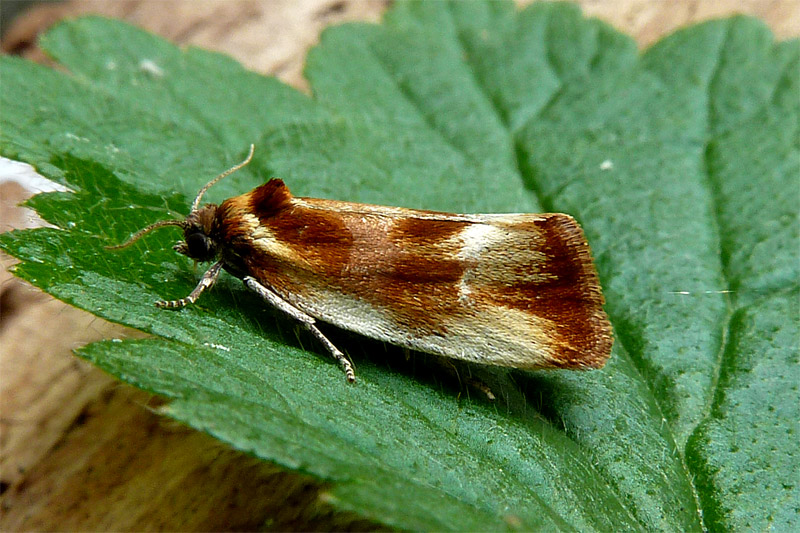
On reaching the line of bushes between the point and the pits I noticed a rather pretty little moth and swiftly potted it up. Photos of the stunner below.


Eulia ministrana

No moths were harmed in the taking of these photos and they were returned home safely.